Image from James Webb Space Telescope (infrared)

Psalm 19:1-6 [German]

1 The heavens declare the glory of God; and the firmament sheweth his handywork.

Day unto day uttereth speech, and night unto night sheweth knowledge.

There is no speech nor language, where their voice is not heard.

Their line is gone out through all the earth, and their words to the end of the world. In them hath he set a tabernacle for the sun,

Which is as a bridegroom coming out of his chamber, and rejoiceth as a strong man to run a race.

His going forth is from the end of the heaven, and his circuit unto the ends of it: and there is nothing hid from the heat thereof.

Die Himmel erzählen die Ehre Gottes, und die Feste verkündiget seiner Hände Werk. Ein Tag sagt’s dem andern, und eine Nacht tut’s kund der andern. Es ist keine Sprache noch Rede, da man nicht ihre Stimme höre. Und ihr Schall gehet aus in alle Lande, und ihre Rede an der Welt Ende. Er hat der Sonne eine Hütte in derselben gemacht; und die selbige gehet heraus wie ein Bräutigam aus seiner Kammer und freuet sich, wie ein Held zu laufen den Weg. Sie gehet auf an einem Ende des Himmels und läuft um bis wieder an das selbige Ende, und bleibt nichts vor ihrer Hitz’ verborgen.

Die Himmel erzählen die Ehre Gottes, SWV 386 (1648), from Geistliche Chormusik, Op. 11, no. 18, composed by Heinrich Schütz (1585-1672)

VOCES8: Die Himmel erzählen die Ehre Gottes by Heinrich Schütz

Performed by VOCES8

Free sheet music at Choral Public Domain Library


Inimicitias ponam (Solesmes version) - the protoevangelium, Genesis 3:15
Inimicitias ponam (Solesmes version)

Genesis 3:15 [Latin] – Also known as the PROTOEVANGELIUM

15 And I will put enmity between thee and the woman, and between thy seed and her seed; it shall bruise thy head, and thou shalt bruise his heel. 

Inimicítias ponam inter te et Mulíerem et semen tuum et semen illíus.

Offertory – Inimicitias Ponam, chant from Graduale Romanum, Solesmes, 1961, p. 584, or The Liber Usualis, Solesmes, 1961, p. 1603

Offertory - Inimicitias Ponam

Sung by Saint Isidore Choir

FREE SHEET MUSIC at GregoBase


Tintoretto: Kampf des Erzengels Michael mit dem Satan (with Woman of the Apocalypse)

Revelation 12:1; Psalm 98:1a [Latin: Apocalypsis 12:1; Psalmi 97:1]

1 And there appeared a great wonder in heaven; a woman clothed with the sun, and the moon under her feet, and upon her head a crown of twelve stars:

1 O sing unto the Lord a new song; for he hath done marvellous things: his right hand, and his holy arm, hath gotten him the victory.

Et signum magnum apparuit in caelo: mulier amicta sole, et luna sub pedibus ejus, et in capite ejus corona stellarum duodecim:

Psalmus ipsi David. Cantate Domino canticum novum, quia mirabilia fecit.  Salvavit sibi dextera ejus, et brachium sanctum ejus.


Signum magnum, chant from Graduale Romanum, Solesmes, 1961, p. 582 or The Liber Usualis, Solesmes, 1961, p. 1601


Performed by The Rose Ensemble

FREE SHEET MUSIC at GregoBase


The Visitation - by The Limbourg brothers
The Visitation – by The Limbourg brothers

Luke 1:46-55 [Latin]

46 And Mary said, My soul doth magnify the Lord,

47 And my spirit hath rejoiced in God my Saviour.

48 For he hath regarded the low estate of his handmaiden: for, behold, from henceforth all generations shall call me blessed.

49 For he that is mighty hath done to me great things; and holy is his name.

50 And his mercy is on them that fear him from generation to generation.

51 He hath shewed strength with his arm; he hath scattered the proud in the imagination of their hearts.

52 He hath put down the mighty from their seats, and exalted them of low degree.

53 He hath filled the hungry with good things; and the rich he hath sent empty away.

54 He hath helped his servant Israel, in remembrance of his mercy;

55 As he spake to our fathers, to Abraham, and to his seed for ever.

Et ait Maria: Magnificat anima mea Dominum: et exsultavit spiritus meus in Deo salutari meo. Quia respexit humilitatem ancillae suae: ecce enim ex hoc beatam me dicent omnes generationes, quia fecit mihi magna qui potens est: et sanctum nomen ejus, et misericordia ejus a progenie in progenies timentibus eum. Fecit potentiam in brachio suo: dispersit superbos mente cordis sui. Deposuit potentes de sede, et exaltavit humiles. Esurientes implevit bonis: et divites dimisit inanes. Suscepit Israel puerum suum, recordatus misericordiae suae: sicut locutus est ad patres nostros, Abraham et semini ejus in saecula.


Magnificat (1610) from Messa e Vespro della Beata Vergine, no. 2, composed by Claudio Monteverdi

Claudio Monteverdi - Magnificat (complete)

Performed by English Baroque Soloists, conductor John Eliot Gardiner

FREE SHEET MUSIC at Choral Public Domain Library


Interior of the Church of St Peter & St Paul, Old Bolingbroke
Dave Hitchborne / Interior of the Church of St Peter & St Paul, Old Bolingbroke / CC BY-SA 2.0

Psalm 47:1-2,7 [Latin: Psalmi 46:2,3,8]

1 O clap your hands, all ye people; shout unto God with the voice of triumph.

For the Lord most high is terrible; he is a great King over all the earth.

For God is the King of all the earth: sing ye praises with understanding.

Iubilate Deo in voce exsultationis quoniam magnus rex super omnem terram psallite sapienter


Iubilate Deo, composed by Massimo Scapin (b. 1968)

Massimo Scapin - Iubilate Deo

^Performed by Sacred Music Project Choir at St. Patrick’s Seminary & University

FREE SHEET MUSIC at Petrucci Music Library


Hyssopus officinalis (Hyssop.) - From Wikimedia Commons
Hyssopus officinalis (Hyssop.) – From Wikimedia Commons

Psalm 51:7,1a [Latin: Psalm 50:9,3a]

Purge me with hyssop, and I shall be clean: wash me, and I shall be whiter than snow.

1 Have mercy upon me, O God, according to thy lovingkindness: according unto the multitude of thy tender mercies blot out my transgressions.

Asperges me hyssopo, et mundabor; lavabis me, et super nivem dealbabor. 

Miserere mei, Deus, secundum magnam misericordiam tuam


Asperges me, composed by Massimo Scapin (b. 1968)

The “Ançã-ble” Vocal Group from Portugal, conducted by Rev. Pedro Miranda, rehearsing Asperges me by Massimo Scapin


William Blake - Wise And Foolish Virgins (1826)
William Blake – Wise And Foolish Virgins (1826)

Matthew 25:4-13 [Latin]

1 Then shall the kingdom of heaven be likened unto ten virgins, which took their lamps, and went forth to meet the bridegroom.

And five of them were wise, and five were foolish.

They that were foolish took their lamps, and took no oil with them:

But [the five wise virgins] took oil in their vessels with their lamps.

While the bridegroom tarried, they all slumbered and slept.

And at midnight there was a cry made, Behold, the bridegroom cometh; go ye out to meet him.

Then all those virgins arose, and trimmed their lamps.

And the foolish said unto the wise, Give us of your oil; for our lamps are gone out.

But the wise answered, saying, Not so; lest there be not enough for us and you: but go ye rather to them that sell, and buy for yourselves.

10 And while they went to buy, the bridegroom came; and they that were ready went in with him to the marriage: and the door was shut.

11 Afterward came also the other virgins, saying, Lord, Lord, open to us.

12 But he answered and said, Verily I say unto you, I know you not.

13 Watch therefore, for ye know neither the day nor the hour wherein the Son of man cometh.

Prudentes virgines acceperunt oleum in vasis suis cum lampadibus suis. Moram autem faciente sponso, dormitaverunt omnes et dormierunt. Media autem nocte clamor factus est: Ecce sponsus venit, exite obviam ei. Tunc surrexerunt omnes virgines et ornaverunt lampades suas. Fatuae autem sapientibus dixerunt: Date nobis de oleo vestro: quia lampades nostrae exstinguuntur. Responderunt prudentes, dicentes: Ne forte non sufficiat nobis, et vobis, ite potius ad vendentes, et emite vobis. Dum autem irent emere, venit sponsus: et quae praeparatae erant, intraverunt cum eo ad nuptias, et clausa est ianua. Novissime vero veniunt et reliquae virgines, dicentes: Domine, Domine, aperi nobis. Ad ille respondens, ait: Amen dico vobis, nescio vos. Vigilate itaque, quia nescitis, neque horam.


Prudentes virgines, composed by Jean Guyot (1512-1588)

^Performed by Cinquecento


“I Thirst” The Vinegar Given to Jesus – James Tissot

Psalm 69:20-21 [Latin Vulgate: Psalm 68:21-22]

20 Reproach hath broken my heart; and I am full of heaviness: and I looked for some to take pity, but there was none; and for comforters, but I found none.

21 They gave me also gall for my meat; and in my thirst they gave me vinegar to drink.

Improperium expectavit cor meum et miseriam et sustinui qui simul mecum contristaretur et non fuit; consolantem me quaesivi et non inveni. Et dederunt in escam meam fel, et in siti mea potaverunt me aceto.


Improperium expectavit cor meum (1593) in Offertoria totius anni, no. 24, composed by Giovanni Pierluigi da Palestrina (1525-1594)

Palestrina: Improperium exspectavit cor meum - Sixteen

^Performed by The Sixteen

FREE SHEET MUSIC in YouTube video above or at Choral Public Domain Library


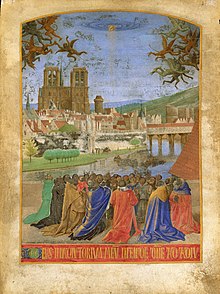
Notre-Dame and the rest of Paris in the background of a c. 1452–1460 illuminated manuscript by Jean Fouquet
Notre-Dame, Paris in the background of an illuminated manuscript by Jean Fouquet

Psalm 118:24,1 [Latin Vulgate: Psalm 117:24,1]  

24 This is the day that the Lord has made; let us rejoice and be glad in it.

1 O give thanks unto the Lord; for he is good: because his mercy endureth for ever.

Haec est dies quam fecit Dominus; exsultemus, et laetemur in ea. Confitemini Domino, quoniam bonus, quoniam in saeculum misericordia ejus.


Haec est, composed by Pérotin (fl. c. 1200)

Pérotin: Haec dies

^Performed by Cantica of the Czech Republic