8 But she being instructed before by her mother, said: Give me here in a dish the head of John the Baptist.
9 And the king was struck sad: yet because of his oath, and for them that sat with him at table, he commanded it to be given.
Da mihi in disco caput Joannis Baptistae: et contristatus est rex propter jusjurandum.
[In YouTube video, adds: “Credidi propter quod locutus sum * ego autem humiliatus sum nimis.” – Psalm 116:10]
—
Da mihi in disco, Antiphon for August 28 and August 29 Vespers, from The Liber Usualis, Solesmes, 1961, p. 1621 or Liber antiphonarius, Solesmes, 1960, p. 830
3 Blessed are the poor in spirit: for theirs is the kingdom of heaven.
4 Blessed are they that mourn: for they shall be comforted.
5 Blessed are the meek: for they shall inherit the earth.
6 Blessed are they which do hunger and thirst after righteousness: for they shall be filled.
7 Blessed are the merciful: for they shall obtain mercy.
8 Blessed are the pure in heart: for they shall see God.
9 Blessed are the peacemakers: for they shall be called the children of God.
10 Blessed are they which are persecuted for righteousness’ sake: for theirs is the kingdom of heaven.
Beati pauperes spiritu, quoniam ipsorum est regnum coelorum. Beati mites, quoniam ipsi possidebunt terram. Beati qui lugent, quoniam ipsi consolabuntur. Beati qui esuriunt et sitiunt iustitiam, quoniam ipsi saturabuntur.
Beati misericordes, quoniam ipsi misericordiam consequentur. Beati mundo corde, quoniam ipsi Deum videbunt. Beati pacifici, quoniam filii Dei vocabuntur. Beati qui persecutionem patiuntur propter iustitiam, quoniam ipsorum est regnum coelorum.
10 But when thou art invited, go, sit down in the lowest place; that when he who invited thee, cometh, he may say to thee: Friend, go up higher. Then shalt thou have glory before them that sit at table with thee.
11 Because every one that exalteth himself, shall be humbled; and he that humbleth himself, shall be exalted.
Cum invitaus fueris ab aliquo, vade et accumbe in novissimo loco ut cum venerit qui te invitavit dicat tibi, amice, ascende superius. Tunc erit tibi gloria coram omnibus discumbentibus, omnis enim qui se extolletur.
—
Cum invitatus fueris ab aliquo, from Motetten der Cantiones Sacrae I (1602), composed by Melchior Vulpius (1570-1615)
Motetten der Cantiones Sacrae I: Cum invitatus fueris ab aliquo
13 Thou waterest the hills from thy upper rooms: The earth shall be filled with the fruit of thy works:
14 Bringing forth grass for cattle, and herb for the service of men. [O Lord,] That thou mayst bring bread out of the earth:
15 And that wine may cheer the heart of man. That he may make the face cheerful with oil: and that bread may strengthen man’s heart.
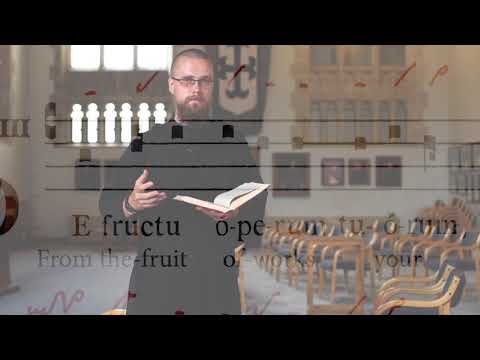
De fructu óperum tuórum, Dómine, satiábitur terra: ut edúcas panem de terra, et vinum lætíficet cor hóminis: ut exhílaret fáciem in óleo, et panis cor hóminis confírmet.
—
Communio: De Fructu, from Graduale Romanum, Solesmes, 1961, p. 353 or The Liber Usualis, Solesmes, 1961, p. 1031
21 His lord said unto him, Well done, thou good and faithful servant: thou hast been faithful over a few things, I will make thee ruler over many things: enter thou into the joy of thy lord.
Euge serve bone et fidelis, quia supra pauca fuisti fidelis, supra multa te constituam. Intra in gaudium Domini tui.
O Lord, the God of my salvation, I have cried in the day and in the night before Thee.
Dómine Deus salútis meæ; in die clamávi et nocte coram te
—
Alleluia: Domine Deus salutis meae, Aria in Ab for soprano, clarinet, and orchestra, music by Wolfgang Amadeus Mozart (1756 – 1791); parody of Mozart’s “Non più tutto ascoltai”
Aria `Domine Deus salutis meae` for soprano, clarinet and orchestra KVdeest - Mozart
11 But Moses besought the Lord his God, saying: Why, O Lord, is thy indignation kindled against thy people? [additional text in liturgy/music: ” Let the anger of Thy mind cease;”] whom thou hast brought out of the land of Egypt, with great power, and with a mighty hand?
13 Remember Abraham, Isaac, and Israel, [additional text in liturgy/music: “to whom Thou didst swear to give a land flowing with milk and honey.”] thy servants, to whom thou sworest by thy own self, saying: I will multiply your seed as the stars of heaven: and this whole land that I have spoken of, I will give to your seed, and you shall possess it for ever.
14 And the Lord was appeased from doing the evil which he had spoken against his people.
Precátus est Móyses in conspéctu Dómini Dei sui, et dixit: Quare, Dómine, irásceris in pópulo tuo? Parce iræ ánimæ tuæ: meménto Abraham, Isaac et Jacob, quibus jurásti dare terram fluéntem lac et mel. Et placátus factus est Dóminus de malignitáte, quam dixit fácere pópulo suo.
[Additional text in recording and linked sheet music below: “Dixit Dominus ad Moysen: Invenisti gratiam in conspectu meo et scio te prae omnibus et festinans Moyses inclinavit se in terram et adoravit dicens: scio quia misericors es in millibus, aufrens iniquitatem et peccata.” Google-translated: “The Lord said to Moses: You have found favor in my sight, and I know that you are above all, and Moses hastened and bowed to the ground and worshiped, saying: I know that you are merciful to thousands, taking away iniquity and sins.”]
—
Offertory: Precatus est Moyses, for Twelfth Sunday after Pentecost, from Offertoriale Sive Versus Offertoriorum Cantus Gregoriani, Vatican-Offertoriale, 1935, p. 97
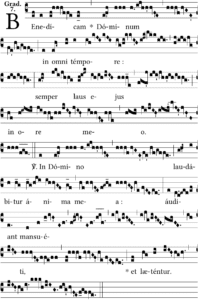
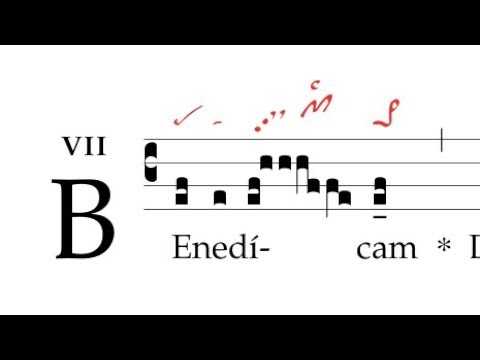
I will bless the Lord at all times; His praise shall ever be in my mouth. In the Lord shall my soul be praised: let the meek hear, and rejoice.
Benedícam Dóminum in omni témpore: semper laus ejus in ore meo. ℣. In Dómino laudábitur anima mea: áudiant mansuéti, et læténtur.
—
Graduale: Benedicam Dominum, for Twelfth Sunday after Pentecost, from Graduale Romanum, Solesmes, 1961, p. 350 or The Liber Usualis, Solesmes, 1961, p. 1028
1 I will bless the Lord at all times: his praise shall continually be in my mouth.
2 My soul shall make her boast in the Lord: the humble shall hear thereof, and be glad.
3 O magnify the Lord with me, and let us exalt his name together.
Benedicam Dominum in omni tempore; semper laus ejus in ore meo. In Domino lætabitur anima mea; Audiant mansueti et lætentur. Magnificate Dominum mecum; et exultemus nomen ejus in id ipsum. Alleluia.
Centre light of the stained glass window in the north aisle of the nave, depicting the Crown of Life. The window was created c. 1919 by the studio Joshua Clarke & Sons, Dublin. Photo by Andreas F. Borchert / CC BY-SA 4.0
12 Blessed is the man that endureth temptation; for when he hath been proved, he shall receive a crown of life, which God hath promised to them that love him.
Beatus vir, qui suffert tentationem: quoniam cum probatus fuerit, accipiet coronam vitae, quam repromisit Deus diligentibus se.



_(CBL_BP_XVII).jpg)





_Decalogvs_cvm_acerbissimis_(serietitel),_RP-P-1981-155.jpg)